Showing posts with label aspirin. Show all posts

Sunday, July 29, 2012

Another Benefit of Wild Salmon

To say I am a wild salmon fan would be an understatement. The more I learn about it, the more excited I get. The other day I wrote about how I was in heaven consuming it in the great Northwest.

Here's another reason (for some a caution) to ingest wild salmon. Interestingly, I just learned about this not very well known benefit.  It's why I say you can never stop pursuing knowledge.

The omega-3 fatty acids in Salmon, eicosapentaenoic acid (EPA, 20 carbons and 5 double bonds), docosahexaenoic acid (DHA, 22 carbons and 6 double bonds), in addition to their positive anti-inflammatory, cholesterol lowering, and brain health effects, also have apparent anti-coagulant benefits that can prevent blood clots.

For most people that's a really good thing to have a natural source of blood thinning as protection against heart attacks and strokes. However, for people on anti-coagulants such as Coumadin, aspirin, Plavix, etc. this may be problematic. If you are on any anti-coagulant(s) and commonly consume salmon, my favorite food, please check with your doctor to determine if your medication needs to be adjusted.

Do not take fish oil pills for this purpose because they are not processed similarly in the body. Flax seeds, which also contain the α-linolenic acid (ALA, 18 carbons and 3 double bonds) omega-3 fatty acids are also noted to have similar benefits.

This is not intended as medical advice and consulting with your own physician is always advised.

Thursday, June 21, 2012

Don't Take Two Aspirins...

We all grew up with the old adage of "take two aspirins and call the doctor in the morning." This saying referred to the advice doctors often gave patients who bothered them by phone late in the day with what the doctor perceived to be a triviality that could wait until the next day or forever, for that matter. Today, when you try to call you doctor later in the day, you often get a voice message that states, if this is an emergency, please call 911 or go to the nearest emergency room. So was it good advice?

Clearly, aspirin is an effective enough fever reducer, pain reliever and anti-inflammatory medicine for mild ailments. However, it's hardly used for such purposes anymore because of superior medications such as acetaminophen (Tylenol) and ibuprofen (Motrin, Advil, etc.) and other non-steroidal anti-inflammatories (NSAIDS).  Aspirin began to decline in usage for pain and fever not only because of the more potent alternatives, but also because an increasing number of people were having allergic reactions to it and it was discovered that children (and some adults) were at risk of developing Reye's Syndrome.

Reye's Syndrome is a deadly disease that strikes quickly and can affect people of all ages without warning. It affects the entire body, but the brain and liver are the most harmed. Although the exact cause and cure are unknown, there appears to be a link between it and aspirin and other salicylate containing medications, and it seems to affect people who have had a chicken pox infection at some point. As the use of aspirin declined, the incidence of Reye's Syndrome has also markedly declined to very rare occurrences. It should stay that way.

More recently, aspirin has regained center stage due to its anti-platelet, anti-clotting abilities. It has also been linked to possible benefit in reducing the risk of colon cancer.  Unfortunately, it also is responsible for most bleeding episodes in the U.S. and is reported to be among the top four reasons for emergency room visits. The bleeding risks are increased by concomitant use of other NSAIDS, and unfortunately, enteric-coated aspirin, does NOT appear to decrease the bleeding risk.  Aspirin can also cause gastric ulcers, and I can confirm that from personal experience.

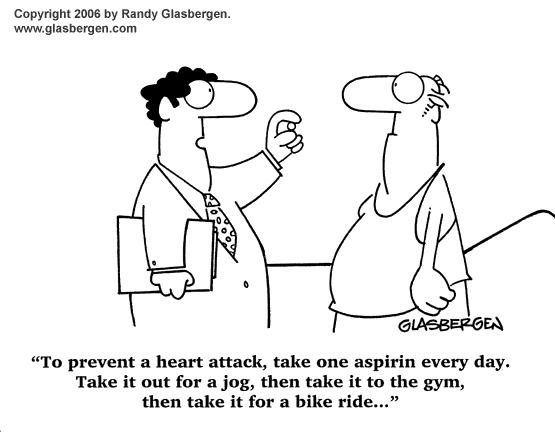
Therefore, the recommendation to consume a baby aspirin (81mg) to prevent blood clots must therefore be balanced against the risk for bleeding, ulcer formation, and the long-shot Reye's Syndrome. A thorough discussion with your doctor can determine if it is the right choice for you based on your risk factors for blood clots. Taking it on your own would not be advised.

That's what most doctors agree is the prudent course, but then again Dr.Oz is no longer like most doctors. An article appearing in this week's People magazine quotes him as saying that everyone should take two baby aspirins every day. Without knowing your risk factors and apparently throwing caution to the wind, he appears to ignore the risk factors for bleeding and ulcers and continues to make this foolhardy recommendation. Sometimes he recommends a fluid with it, but I have heard him say on his show to take aspirin without mentioning the need for fluids. Fluids are said to decrease the corrosive nature of aspirin on the lining of your stomach. I wish he would add at least a whisk of caution to his recommendation, if not stop it altogether.

By the way, you may ask, why do I keep writing about Dr. Oz?  As I've said before, it's because he's everywhere I turn (everyone turns) and quoted widely. His words are taken seriously by many people and I fear for the consequences.

A reporter for a Canadian major newspaper, whom I wrote about previously and spoke to the other day, told me that when she was among other reporters interviewing Dr. Oz when he visited Canada, she was the only reporter who did not get a hug because she asked him tough questions he apparently didn't appreciate.  Her conclusions after interviewing him is that he rationalizes promising miracle cures and magic pills (which he knows don't exist) and pushing products that are potentially harmful by telling himself that people need false hope and emotion to drive change.

I say people need good information to make good choices in consultation with their doctors. On that point, Dr. Oz and I seem to be diametrically opposed and that is why I keep trying to educate the public. 

MDPrevent

Wednesday, June 6, 2012

And The Study Showed What?

Virtually not a day goes by that headlines don't blare the results of some new medical studies.  Just today, two studies caught my attention. One showed that even low-dose aspirin is associated with a significant increased rate of bleeding episodes and another showed that ginseng improved fatigue in cancer patients.

As with all studies, these two demanded closer attention to understand if they were even reliable. They were both pretty good studies but not easily applicable to the layperson. They require further consideration based on personal circumstances.  Today, I want to educate you about any study you may come across.  There are seven questions to ask yourself whenever you see a medical related study. I will present each question with some thoughts.

Was it a study in the laboratory, in animals, or in people?

As far as I am concerned, the only studies that truly matter involve people. That's the only way to know for sure how it will affect most people.

Does the study include enough people like you?

If you are an Asian-American and the study was done in African-Americans, it may not be relevant to you. Likewise, if you are Okinawan and the study was done with Ashkenazi Jews. The most relevant studies for you are the ones done in your ethnic group, age group, gender, economic and social level, health state, and disease state. Notwithstanding, studies done in any humans can be expected to have some relevance to all humans.

Was it a randomized controlled clinical trial involving thousands of people?

These are the gold standard studies and can be best relied upon. They are also very expensive to do, so you don't see them often enough.

Where was the research done?

Better research facilities typically do better research. For example, a study done at a top medical school or large hospital system, may have greater resources to perform complicated experiments or have deeper experience with the subject matter. The best studies involve multiple, quality institutions working together.

If a new treatment was being tested, were there side effects?

Authors report results because of an intended consequence. For example, statins lower cholesterol. But they also increase your risk for diabetes. When results are reported, they often play down side effects but these side effects may be highly problematic for you personally. Therefore, don't just focus on what the main thrust of the study was, but also review what side effects it caused.  Sometimes the cure can be worse than the disease. 

Who paid for the research?

This is a big one. Who controls the results? Is there a conflict of interest? For example, is the Cattle Rancher's Association paying for a study to show the health benefits of meat? If so, do they have final say on withholding negative results? Can they repeat the experiment ten times and report the one time it worked in their favor?  Federal government studies, like the National Institutes of Health, or a large foundation not supported or beholden to industry, are the most reliable sources of funding. With new drugs, it's a different story. Clearly, the study is paid for by the pharmaceutical company and they stand to benefit from positive results. However, the results are reviewed by the FDA and there can be a fair amount of reliance that the process has undergone the necessary scrutiny. Notwithstanding, it is an imperfect process that sometimes goes awry. 

Who is reporting the results?

The source of the news about the study may be the most important fact to consider. News media can often distort study results for a certain newsworthy angle. Never rely solely on one source of news regarding a study. Also, be careful of interpretations of studies. Know who is interpreting it and what dog they have in the fight.

Ultimately, the best approach to understanding the significance of any study is to share it with your doctor and to figure out together if it applies to you. I always say, an educated patient is my favorite kind.