Showing posts with label MDPrevent. Show all posts

Tuesday, July 3, 2012

Press Release For Thursday July 5, 2012


MDPrevent & Consumer Reports Agree 
On The Need For Preventive Medicine
MDPrevent Offers The “Prevention Attention” 
Advocated For By July 2012 Issue

MDPrevent, a primary care medical practice focused on preventive medicine and wellness offers the full range of preventive medicine and wellness services desired by patients.
Delray Beach, FL July 3, 2012
According to Consumer Reports on Health (CR), “Immunizations, cancer screenings, lifestyle counseling, and other wellness measures can save lives. But your doctor may be falling short when it comes to making sure you’re up to date on the services you need.” CR cites a January 2012 study published in the American Journal of Preventive Medicine to support is conclusions.
CR is spot on. In 2011, Medicare implemented new coverage for Annual Wellness Visits (AWV) as part of a growing menu of preventive services. As with many other preventive services, the AWV requires no co-payment or deductible.  Yet, in 2011, only 6% of patients received this service from doctors who performed it and many did not receive the proper service. Why? As CR writes, “wellness gets squeezed” because “it doesn’t pay for doctors” to do it, for many doctors “its awkward territory,” and “most doctors don’t have the time.” Wellness, according to CR, when even done, is typically not the “focal point”; rather, “wellness gets squeezed into visits when people have a problem.”  
Working within Medicare’s guidelines for AWV, MDPrevent, a primary care, preventive medicine, and wellness center was launched to fully address the wellness needs of Americans. MDPrevent’s innovative medical practice combines in one location the expertise needed to provide the full spectrum of wellness services. With a team consisting of a physician, nurse practitioner, nutritionist/registered dietitian, health psychologist, fitness and yoga instructor, and health educator, MDPrevent can uniquely help patients enjoy life to the fullest, free of disease.
The MDPrevent model is sure to become the future of integrative medicine enabling patients to draw on the full expertise and guidance they need from their primary care office to avoid, delay, or mitigate chronic diseases and improve their current quality of life.
As one part of MDPrevent’s offerings, it custom developed the LEAN program, a medically supervised 12 week personalized lifestyle modification program that includes initial medical assessment, coupled with private consultations with a nutritionist/dietitian, psychologist, fitness and yoga instructor, and health educator, and rounded out with a final medical assessment. Patients then continue with private consultations as needed or join support group and educational group sessions. The program aims for slow, but steady and sustainable lifestyle modification and weight loss by focusing on healthy living and well-being. In addition, MDPrevent is also a Certified Diabetes Education Center catering to the nutritional and educational needs of diabetics.
MDPrevent was founded by Dr. Steven Charlap, a pioneering physician with an MD from New York University, an MBA from Harvard, and general surgery training. In 1989, he founded HealthDrive, which grew it to be the largest U.S. medical and dental practice serving the extended care industry. Over twenty years, HealthDrive cared for over 5 million seniors and Dr. Charlap witnessed first-hand what happens to people who don’t take adequate care of their health, are institutionalized and become dependent on the kindness of strangers. According to Dr. Charlap, “It is sad to see people end their lives in a nursing home. You realize that in such a setting relatively little can be done to improve health at that point. Even more frustrating was that one couldn’t even try because Medicare and Medicaid basically shunned preventive services.”
In 2010, after Dr. Charlap learned that Medicare was initiating coverage for wellness services that can positively impact people’s lives while saving Medicare money, he founded MDPrevent to create an innovative preventive medicine, primary care, and education center focused on providing community based services to help people change their lifestyles to avoid and mitigate chronic diseases. Dr. Charlap states, “The scientific evidence shows that the longer you live, the healthier you’ve been.” After extensive research and consultations with the experts in the field of primary prevention, an interdisciplinary dream team of Preventioneers was assembled.
Testimonials from patients include comments like, “I finally have my head on straight” or “it’s changed my life.” (See www.mymdprevent.com, Testimonials). According to Dr. Charlap, “I see the smiles on people’s faces when they complete a session for the day. They feel empowered and for the first time in a long time, in control of their health and their weight. I know we are really on to something that can change the future of healthcare.”
About MDPrevent
MDPrevent is a new concept in primary care that seamlessly integrates primary care, preventive medicine, and wellness. The healthcare practice helps American’s prevent problems before they happen, reduce healthcare costs, stay healthy, and enjoy a life well lived through free Annual Wellness Visits (paid 100% by Medicare and most major insurances) The Annual Wellness Visit includes a comprehensive health risk assessment, biometric measurements, review and analysis of prescription, supplement and vitamin use, nutrition review, and development of a five- to 10-year prevention plan.
MDPrevent’s Preventioneers, or Prevention Pioneers, include MDs, nurse practitioners, health psychologists, registered dietitians and nutritionists, fitness and yoga instructors, and health educators, offer private consultations and experiential group sessions, medically supervised weight loss (with no pills, injections or surgery - paid 100% by most insurances if you qualify) and other classes on health, diet and nutrition, fitness and exercise, stress management, mindfulness, relationship and social network building, and other key elements of a healthy life. The goal: to improve life and smooth out the effects of aging by identifying, preventing, delaying or mitigating the development of chronic diseases such as heart disease, diabetes, stroke, dementia and some forms of cancer. Learn more at http://www.MyMDPrevent.com. Read Dr. Charlap’s blog at mdprevent.blogspot.com
MDPrevent
5130 Linton Blvd. Suite H1
Delray Beach, FL 33484
(561) 807-2561

Thursday, June 28, 2012

Dr. Oz, Green Coffee Extract, and Dietary Supplement Beliefs


In September 2011, John Cloud, a writer for Time Magazine, published an article about his own experience with dietary supplements titled: "Why Most Dietary Supplements Aren’t Worth the Money." Using himself as the subject of his home-based experiment, he took 3,000 pills over a 5 month period to see what effect it would have on his health. Checking his blood at the beginning and end of the the trial period revealed that the "lab rat experiment," as he referred to it, changed nothing except for his weight.

As a result of consuming some twenty pills a day, which he thought must provide some protective health benefits, he rationalized that he had a license to eat poorly, and as a result, gained 15 pounds.  Obviously, this one man study is not extrapolatable, but it is a curiosity.  What effect would these same pills have on the health of others?  The comments posted online in response to Mr. Cloud's article were generally negative. Most responders railed at how he basically proved nothing and failed to recognize the true value of taking supplements.

You may remember my blog on March 18, titled A New Religion Is Sweeping America. I called this religion Supplementum, and it referred to the unshakeable belief that many people hold that the dietary supplements they take are what is keeping them healthy. They have a fervent religious faith in these pills that rivals any other possible religious belief. They often refer to the studies that prove that their supplements are the right ones. By refer, I mean state that there are such studies, but of course, can't produce them.

Everyday, I try to read studies and articles from reliable, and sometimes not so reliable sources about dietary supplements. Often, there are comments associated with such articles, and as with the John Cloud article, the comments almost always vigorously defend the use of supplements based on purported studies. However, I can't usually find such studies (most don't exist!?).  More importantly, when I do, the studies are usually worthless.

For example, Dr. Oz recently promoted Green Coffee Extract as an effective weight loss supplement. It has become a rage on the internet as the next great weight loss product. Oz did so based on quoting a recent study. I believe I found the study to which he was referring. The study involved sixteen people and was performed in Bangalore, India (with some involvement from the chemistry and psychology departments at the University of Scranton).  I found discrepancies in the study and emailed specific questions to the author in India. He actually responded to write that he will be in touch again. I am still waiting.

However, the author of the study made passing reference that upon follow-up (time period not given) to the study, the subjects who had lost weight had kept it off. This doesn't make much scientific sense as the effects should wear off after the study is done. It was also presented as a double-blind randomized control study, but was in fact, a cross-sectional study, which means that all study subjects both received the product (in two different doses) and the placebo at one point, which means that they all lost weight when they took the highest amount and apparently kept it off, regardless of what they received first.  At least a third received the full dose first, and another third received the half dose first.


Ignoring the fact that a 16 person study is essentially nonsensical for scientific validity, other aspects of the study also were illogical. The argument for the green coffee extract is that it prevents absorption of glucose thereby reducing calorie intake thereby resulting in weight loss. By description, it works actively to prevent such absorption. It should work as an active ingredient similar to the short-term effects of drinking coffee.


Again, this makes no sense because if they received the product first, and kept off the weight, what effect did the placebo even have? The study also states that the study subjects may have figured out when they got the placebo and when they got the coffee extract. Not quite a blind study then, huh? Finally, there was no actual description of what the subjects ate during the study.  I think everyone can agree that would make a huge difference on weight gain or loss.

Today, a patient of mine that regularly corresponds with me responded to my advice for her to take a vacation from her daily supplements. She is a true believer in supplements. Her response was that she does for a month whenever she goes for blood work and when she stopped it one time, the pressure in her eyes increased so much she needed surgery from which she is still recovering. Pressure in the eyes is referred to as Glaucoma, and based on my research there is no body of good evidence that any supplements have any effect on this medical condition. (There are studies that show some benefit with macular degeneration, another eye condition, but that's a subject for another day. I also recently heard a leading ophthalmologist trained at the University of Pennsylvania state the same conclusion.)

Nevertheless, she believes wholeheartedly that stopping the supplements caused the increase in pressure. Of course, I can't know for certain that it didn't, but I suspect that it was happenstance because if it happened once, it should have happened every time, and again, there is no science to support her assertion.

As my wellness and preventive medicine practice grows, I often encourage patients to take these supplement holidays and I will tell you that the feedback has been nothing less than euphoric. The blood-work I perform after a month of supplement holiday, just as with John Cloud, generally show no difference. Why?  Because most of what my patients were taking is treated by the body as excess and is excreted away.  (The old joke is that people who take costly dietary supplements have the most expensive urine.)

Interestingly, people who stop the supplements report that they have more energy than they have had in a long time. This is a subjective report and I also don't put much faith in it.  My thinking, albeit not fully confirmed, is that most supplements usually have little to no short-term effect, despite the subjective reports, and mostly negative or also little to no long term effects.  

My biggest concern is for those patients that have become so psychologically dependent on these pills that they have been taking for so long that they are truly afraid to stop them. I really feel for these patients and pray that they ultimately don't do themselves any real long term harm. In the interim, I am delighted to report that the number of patients who wisely are stopping these wasteful and potentially harmful pills continues to grow with no appreciable difference noted in their health or blood-work.

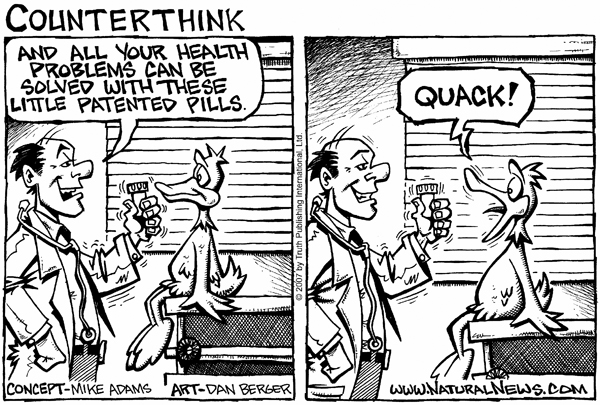
If you are taking such pills, please allow me to prove to you that you also probably don't need most of what you are taking under any circumstances and definitely less so if you make some tweaks to your diet.  As the cartoon above humorously depicts (this was proved in actual study conducted by Cornell University), marketing can be very persuasive. Don't let the supplement marketers and their TV pitchmen have their way with you.  I'm not sure they really have your best interests at heart.

Thursday, May 10, 2012

What Are We Waiting For?

I've participated in many discussions about why people would prefer to treat medical problems as opposed to preventing them. Opinions have ranged from that people are often in denial that something bad will happen to them to they think that genetics plays such a big role that it doesn't really matter what they do within reason. Others believe in the strength of our medical system so that if something bad does happen, the system will fix it. The most common opinion is that is just tough to change bad habits developed over many years and they will hope for the best.

Unfortunately, they are wrong on many counts. Everyone knows someone who died prematurely and so we know bad things can happen to anyone. Genetics plays a relatively small role, less than 30% in our health. The health care system is strong on science, but weak on miracles. Letting your health deteriorate and relying strictly on health care providers is a risky bet. Habits may be hard to break, but they are not impossible to change. Support, guidance, and good knowledge can help.

I think the real problem why we don't focus on prevention is because there is a perverse incentive for the health care system to allow you to get sick so it can treat you. And by health system I mean pharmaceutical companies, health insurance companies (they charge premiums based on a cost plus basis), and of course health care providers, which include hospitals, doctors, and suppliers, who are generally only paid for treating a problem, not preventing it.

A number of year ago, I read an article about how the pharmaceutical industry hardly ever works on developing preventive medicines because it doesn't think there is a market for it.  Some may think that Statins, the cholesterol lowering drugs, are of a preventive nature, but they would be wrong. Statins are only prescribed (and at that, at an excessive rate) only when you already have elevated cholesterol. I don't blame the pharmaceuticals. Why create something for which there is little demand?

So we know the problem, what should we do about it?

My answer is education. education, education. Let's expose our citizenry to a series of self-administered quizzes about their health. Let's open their eyes to the consequences of their behaviors likely to lead to the development of chronic diseases. Let's require schools to school our children to a level where they can demonstrate a fundamental knowledge of what eating properly looks like, the importance of physical activity, and how to best manage stress.

Let's require that every insured patient submit to an annual wellness visit within 90 days of their insurance renewal to stay insured. Let's require during that visit a specific review of medical and family history and dietary, physical activity, sleep, and stress patterns. Let's also do a thorough review of medications and dietary supplements to make sure that they are being used sensibly.  In its totality, this visit will force, yes force, people to take stock of their health before something goes wrong. I believe that while all may not respond well to such a requirement, enough will benefit for it to make a huge difference.

As a society that insures every person over the age of 65, we can no longer afford to hope for the best when it comes to the future of our health care system. We need to get serious about propagating wellness and lifestyle modification and it all starts with education.

This week, Centers for Medicare and Medicaid Services (CMS) announced the first round of grants for its Health Care Innovations Challenge Program. There are certainly a number of meritorious applications among them that will improve our health care system. But sorely lacking among the first group was any real focus on education and primary prevention. Does our government appreciate that an ounce of prevention is really worth a pound of cure? One can only hope that in the next round, to be announced in early June, this absence will be remedied.

We will all be better served if we stop, or even slow down, the progression of avoidable chronic diseases among our populace.  For that, we need our government to help fund such efforts.

Wednesday, May 9, 2012

Better Than The Alternative

It's often been said that laughter is the best medicine. Humor can also be a great way to communicate bad news in a less offensive manner. I love this cartoon because it really summarizes the reality of the situation for people who live sedentary lifestyles or hardly exercise.

Study after study now shows the dramatic impact that moderate physical activity has on your health. It reduces heart attacks and strokes, improves cognitive function and memory, alleviates depression, prevents and reduces the consequences of diabetes, etc.  The flip side is that lack of exercise increases your risk for osteoporosis and dementia. Bad things happen to people who don't move!

So folks, what are you waiting for? If you don't like gyms, find a hobby that requires physical exertion. Take steps, park far away from your destination, mow the lawn, wash the car, wash it again, whatever you do just keep moving. Get up, get out, and live the one life you have to the fullest.


 You may find this cartoon amusing, but don't let it be you. 
You are only fooling yourself by pretending to exercise.
A word to the wise should be sufficient.