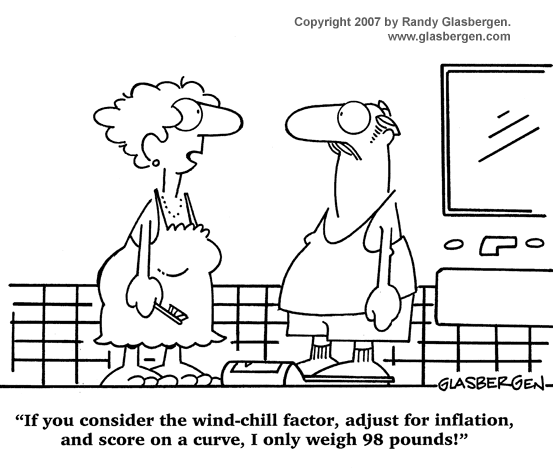
In my previous blog "Why You Get Fat...," I explained that there are five factors that contribute to weight gain (medical, diet, physical activity, sleep and stress). Of course, to lose weight you must address these factors. But once you have gained weight, to shed the unhealthy excess pounds becomes more complicated than just confronting the factors that caused you to get fat in the first place. That's because your body actually doesn't want to give up it's fat stores. It sees fat as energy storage and is invested in the rainy day theorem that you can never have enough fat for difficult times.
(In fact, according to a recent study dealing with diabetes, as the disease progresses, the human body begins to waste away. Therefore, the study showed that those with more body fat actually fare better because they survive longer. Diabetics take note: Just because extra fat can sometimes have perverse benefits, please don't let your disease get to that wasting away stage because there are ways to prevent such progression. Nevertheless, for most people excess weight actually causes problems like the metabolic syndrome with elevated blood sugar, cholesterol, triglycerides, and blood pressure.)
So, why you stay fat has a lot to do with why and how you try to lose the weight.
The most simplistic, albeit meaningless, answer as to why must people stay fat is because as Albert Einstein once gave as the definition of insanity, they do the same thing over and over again and expect a different outcome. They bounce from one diet plan to another. Or they look to miracle cures, magic pills and quick fixes, offered by the likes of Dr. Oz and thousands of other pill-pushers. They know such approaches never offer permanent solutions, but they are so desperate, they will try anything. (I make this point in the hope that by sheer dint of repetition it will eventually sink in.)
They try diets that include cookies, low-carb and high fat, hCG injections, appetite suppressants, calorie restrictions, gluten free, vegan, etc. and still inevitably end up around the same weight or worse.
The real problem is that most people never truly understand why they got fat other than thinking they simply ate too much. In response, they spend their time and money floundering around in search of ways to control their appetites, chasing the latest and greatest fad.
Everyone knows and many have tried diet programs with names like Atkins, The Zone, South Beach, Weight Watchers, Medi-fast, etc. and yet.... if it was only that simple. Diet programs fail for most people.
I think, based on now treating hundreds of patients with weight problems, that there's a much more profound reason why people keep their excess weight. Please read on to learn what I hope will be a new, life-changing perspective.
Patients who come to me for treatment of a weight problem often ask me during our first encounter if I am a psychologist or a physician. (I am the latter.) The reason is that our first meeting often begins with a discussion about their motivation. When someone has gained a lot of weight, even reaching a point where they are defined as obese, the road back can be difficult and challenging. In order to succeed, one has to have the right attitude and be optimistic, if not confident that if he or she does the right things, success will follow. Most importantly, they must be motivated to do so.
In order to gauge such motivation, I often ask a simple question, "Why are you here?" If they answer "to lose weight," I counter with "Why do you want to lose weight?" Some look at me puzzlingly when asked such a question as if the answer is obvious. Others chip right in with answers that range from the aesthetic, "because I want to look better" to the practical "I want to feel better." Some proceed to elaborate how they are sick and tired of feeling sick and tired.
But virtually all patients pause to answer my next question which is a variation of "Why do you want to look or feel better?" They puzzlingly ponder how I could ask such a question, so much so that I often have to repeat it to get an answer.
After a few more iterations of my probing deeper into their answers, we eventually settle on that aspect of their life which is what they label as their number one priority. We identify that aspect of their life for which they are motivated to make sacrifices to succeed. While I encounter a wide variety of ultimate answers, with most often including reference to grandchildren and spouses, we also sometimes settle on what appear to be mundane core statements such as "I truly enjoy life and just want to keep going" or "I have a fear of death and want to delay it as long as possible." These actually reveal a far deeper motivation as they strike to the essence of one's perspective.
With a candid answer finally in hand, my questions turn to how much do they want to succeed on a scale of 0 to 100. Any answer that is less than 100 is met with further probing questions about why they are not 100% motivated to succeed. There is no right answer and 100 may simply never be in the cards for some, but it is very important for both the patient and I to know exactly what their motivation is to lose weight and how motivated they truly are to succeed. (The spouse sitting next to them and prodding them usually doesn't work.)
Take a moment and ask your self the same questions. Challenge yourself to find YOUR truth. Keep asking yourself the question until you reach past the easy, cheap answers. Dig deeper until you are absolutely certain you fully understand your motivation(s) and how deep they run.
Everyone's reasons are different. One poignant example illustrates this point. A patient once shared that although she was married, she loved another man. Although she longed to be with this other person, she was committed to her husband and was steadfast in her fidelity. However, she believed that if she outlived her husband (of course, dying from natural causes and not foul play), then she may eventually have the opportunity to spend some time with her true love. Her commitment to increase her health and lose weight was based on this single desire. It is difficult as a physician to hear about a patient's torment, but I was delighted to help the woman articulate her ikigai (Japanese for purpose in life) that would lead her to make positive life-altering changes to her health.
(By the way, it is never my place to judge, but it is always to help. I respect the diversity in people and recognize the very different lives they have lived. No one can, or should ever presume why someone does what he or she does. Studies show that some people gain weight because it offers a protective shield around them from the cruel world in which they suffered childhood adverse events. Some studies have shown a direct linear correlation between the number of vices, such as binge eating and alcoholism, and the number of adverse childhood events, like the loss of a parent, living with an alcoholic parent, or experiencing some form of abuse before the age of 10. In such cases, identifying such traumas and dealing with them is vital to changing eating habits. So the next time you see a heavy weight person, please hold back judgment. You certainly have no idea what led to his or her weight gain.)
End of Part One. See next blog for Part Two.
www.mdprevent.net
www.myMDPrevent.com
(561) 807-2561
(In fact, according to a recent study dealing with diabetes, as the disease progresses, the human body begins to waste away. Therefore, the study showed that those with more body fat actually fare better because they survive longer. Diabetics take note: Just because extra fat can sometimes have perverse benefits, please don't let your disease get to that wasting away stage because there are ways to prevent such progression. Nevertheless, for most people excess weight actually causes problems like the metabolic syndrome with elevated blood sugar, cholesterol, triglycerides, and blood pressure.)
So, why you stay fat has a lot to do with why and how you try to lose the weight.
The most simplistic, albeit meaningless, answer as to why must people stay fat is because as Albert Einstein once gave as the definition of insanity, they do the same thing over and over again and expect a different outcome. They bounce from one diet plan to another. Or they look to miracle cures, magic pills and quick fixes, offered by the likes of Dr. Oz and thousands of other pill-pushers. They know such approaches never offer permanent solutions, but they are so desperate, they will try anything. (I make this point in the hope that by sheer dint of repetition it will eventually sink in.)
They try diets that include cookies, low-carb and high fat, hCG injections, appetite suppressants, calorie restrictions, gluten free, vegan, etc. and still inevitably end up around the same weight or worse.
The real problem is that most people never truly understand why they got fat other than thinking they simply ate too much. In response, they spend their time and money floundering around in search of ways to control their appetites, chasing the latest and greatest fad.
Everyone knows and many have tried diet programs with names like Atkins, The Zone, South Beach, Weight Watchers, Medi-fast, etc. and yet.... if it was only that simple. Diet programs fail for most people.
I think, based on now treating hundreds of patients with weight problems, that there's a much more profound reason why people keep their excess weight. Please read on to learn what I hope will be a new, life-changing perspective.
Patients who come to me for treatment of a weight problem often ask me during our first encounter if I am a psychologist or a physician. (I am the latter.) The reason is that our first meeting often begins with a discussion about their motivation. When someone has gained a lot of weight, even reaching a point where they are defined as obese, the road back can be difficult and challenging. In order to succeed, one has to have the right attitude and be optimistic, if not confident that if he or she does the right things, success will follow. Most importantly, they must be motivated to do so.
In order to gauge such motivation, I often ask a simple question, "Why are you here?" If they answer "to lose weight," I counter with "Why do you want to lose weight?" Some look at me puzzlingly when asked such a question as if the answer is obvious. Others chip right in with answers that range from the aesthetic, "because I want to look better" to the practical "I want to feel better." Some proceed to elaborate how they are sick and tired of feeling sick and tired.
But virtually all patients pause to answer my next question which is a variation of "Why do you want to look or feel better?" They puzzlingly ponder how I could ask such a question, so much so that I often have to repeat it to get an answer.
After a few more iterations of my probing deeper into their answers, we eventually settle on that aspect of their life which is what they label as their number one priority. We identify that aspect of their life for which they are motivated to make sacrifices to succeed. While I encounter a wide variety of ultimate answers, with most often including reference to grandchildren and spouses, we also sometimes settle on what appear to be mundane core statements such as "I truly enjoy life and just want to keep going" or "I have a fear of death and want to delay it as long as possible." These actually reveal a far deeper motivation as they strike to the essence of one's perspective.
With a candid answer finally in hand, my questions turn to how much do they want to succeed on a scale of 0 to 100. Any answer that is less than 100 is met with further probing questions about why they are not 100% motivated to succeed. There is no right answer and 100 may simply never be in the cards for some, but it is very important for both the patient and I to know exactly what their motivation is to lose weight and how motivated they truly are to succeed. (The spouse sitting next to them and prodding them usually doesn't work.)
Take a moment and ask your self the same questions. Challenge yourself to find YOUR truth. Keep asking yourself the question until you reach past the easy, cheap answers. Dig deeper until you are absolutely certain you fully understand your motivation(s) and how deep they run.
Everyone's reasons are different. One poignant example illustrates this point. A patient once shared that although she was married, she loved another man. Although she longed to be with this other person, she was committed to her husband and was steadfast in her fidelity. However, she believed that if she outlived her husband (of course, dying from natural causes and not foul play), then she may eventually have the opportunity to spend some time with her true love. Her commitment to increase her health and lose weight was based on this single desire. It is difficult as a physician to hear about a patient's torment, but I was delighted to help the woman articulate her ikigai (Japanese for purpose in life) that would lead her to make positive life-altering changes to her health.
(By the way, it is never my place to judge, but it is always to help. I respect the diversity in people and recognize the very different lives they have lived. No one can, or should ever presume why someone does what he or she does. Studies show that some people gain weight because it offers a protective shield around them from the cruel world in which they suffered childhood adverse events. Some studies have shown a direct linear correlation between the number of vices, such as binge eating and alcoholism, and the number of adverse childhood events, like the loss of a parent, living with an alcoholic parent, or experiencing some form of abuse before the age of 10. In such cases, identifying such traumas and dealing with them is vital to changing eating habits. So the next time you see a heavy weight person, please hold back judgment. You certainly have no idea what led to his or her weight gain.)
End of Part One. See next blog for Part Two.
www.mdprevent.net
www.myMDPrevent.com
(561) 807-2561